

Types of Rotary Joints: A Complete Guide to Designs and Configurations
Why Rotary Joint Types Matter
Search for “rotary joint” and you will find an alphabet soup of names: rotary union, rotary coupling, swivel joint, rotating joint. In most cases these are the same device — a sealed passage between a stationary supply line and a rotating machine part. (We break down the naming debate in Rotary Joint vs Rotary Union vs Rotary Coupling.)
What genuinely differs between products is the type — the internal flow path, the connection style, the seal design, and the duty class it is built for. Choosing the wrong type is the root cause of most premature leaks.
This guide walks through every category of rotary joint types, then maps each type to a concrete Ruitus series so you can go straight to specifications.
Classification 1: By Flow Path
The most fundamental distinction is how many media circuits pass through the joint.
- Single-flow rotary joints (uni-flow): One medium in, one medium out. The standard configuration for water, coolant, steam, and thermal oil duty — for example the RTH series and RTQ series.
- Dual-flow rotary unions (duo): Two independent circuits through one joint — typically supply and return. Common in roll cooling where cold water goes in and warm water comes back.
- Multi-passage rotary joints: Three or more independent circuits, often combining media (water, air, hydraulic oil) and electrical signals. Found on steel-mill equipment like ladle turrets and continuous casters — see the multi-passage custom rotary joint with 20+ passages.
Rule of thumb: count the hoses connected to your existing joint. Each pair of ports is one circuit.
Classification 2: By Connection and Mounting
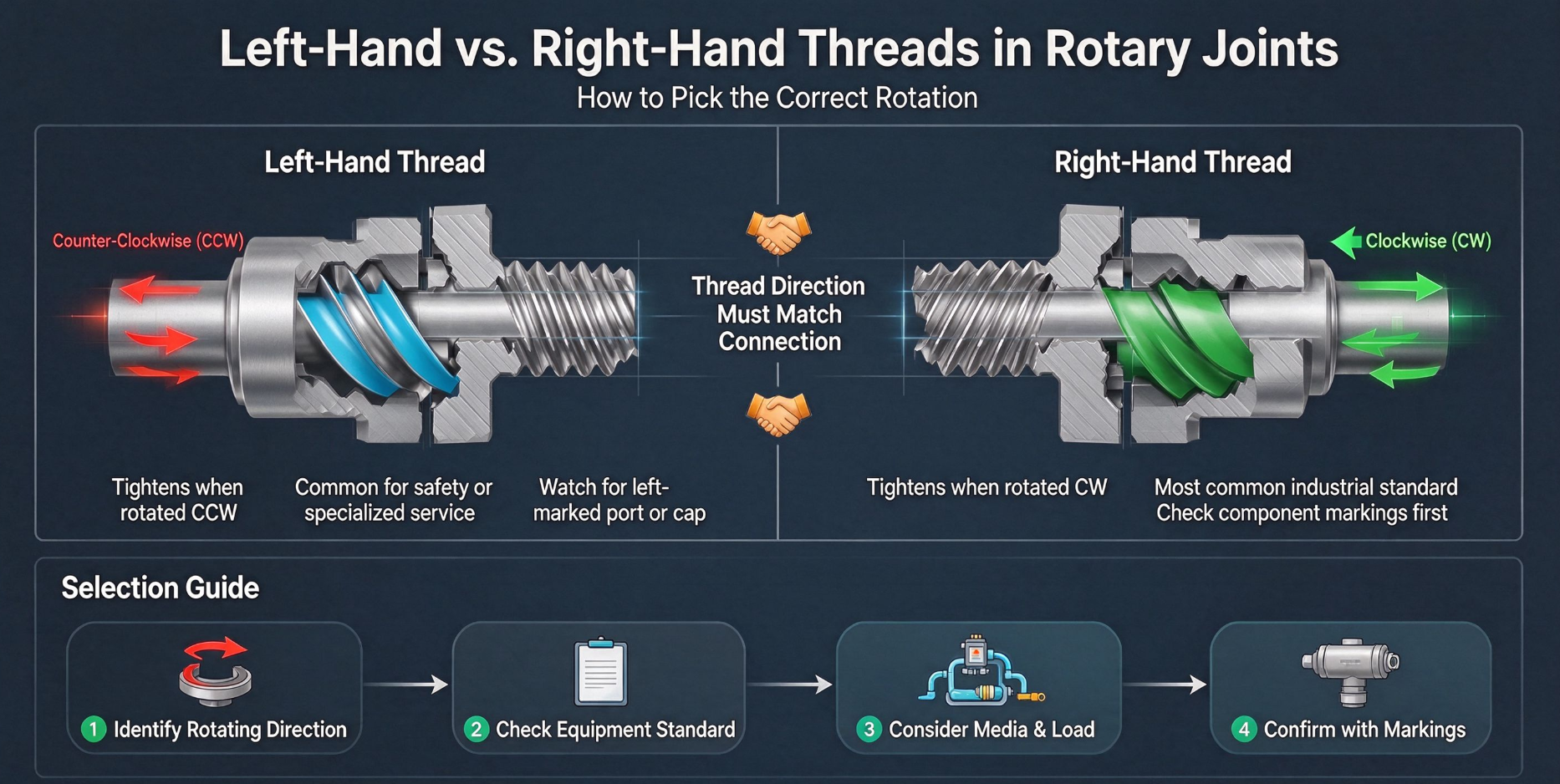
- Threaded connections (G, NPT, BSP): The default for sizes up to DN50 (2 in). Easy to install and swap — but always verify thread handedness against shaft rotation (left-hand vs right-hand threads explains how).
- Flanged connections: Preferred for larger sizes, higher pressures, and heavy duty. Bolted flanges resist vibration and make alignment easier.
- Hollow shaft / through bore rotary unions: The bore runs right through the joint so a shaft, bar stock, or cable can pass across the rotation interface. CNC spindles are the classic case — the RT-DE CNC through-spindle joint passes coolant through a rotating tool at up to 10,000 rpm.
- Swivel joints (U-type / L-type): Elbow-shaped joints that change the media direction by 90° while rotating. See the U-type swivel joint and L-type swivel joint.
Classification 3: By Seal Design
The seal is the wearing part — and the design decides how long it lasts.
- Balanced seal: Pressure-generated closing force is internally offset, so the seal faces stay loaded evenly at high pressure and speed. Most modern rotary unions use balanced seals — details in Balanced vs Unbalanced Seal.
- Unbalanced seal: Simpler and cheaper, fine for low-pressure water and air duty. Wear accelerates above roughly 1.0 MPa.
- Multi-spring vs single-spring: Multiple light springs keep the faces parallel even as they wear. The RTH series uses an external multi-spring balanced design that is easy to service.
- Seal face materials: Carbon graphite (general duty), silicon carbide (hot water, steam), tungsten carbide (abrasive media). Housing materials run from forged brass to stainless steel — compared in Stainless Steel vs Brass Rotary Joints.
Classification 4: By Duty Class
This is how most engineers actually search for a joint — by the demanding condition it must survive.
High Pressure Rotary Joints
For hydraulic circuits and hydrostatic test rigs — 4 to 100 MPa. The hydraulic family uses heavy-duty housings and O-ring or special seal stacks: RT-GY series (up to 100 MPa), RT-JG series and JL-DD/JL-DC series (35 MPa class). More field context in Hydraulic Rotary Joints in Steel Mills.
High Speed Rotary Unions
From 1,000 rpm up to 10,000 rpm+. Balancing, bearing selection, and seal face finish dominate the design. The patented RTH multi-spring design runs to 3,000 rpm; RT-DE series handles 5,500 rpm; CNC through-spindle units reach 10,000 rpm — covered in High Speed Rotary Joints.
High Temperature Rotary Joints
Steam and thermal oil duty, up to 350°C / 2.0 MPa. The RTQ series is purpose-built for saturated steam and hot oil with anti-scaling carbon faces. If you are deciding between media, read Steam vs Thermal Oil Rotary Joints.
Miniature and Compact Rotary Joints
Small envelopes (from DN6), low torque, light weight — packaging machines, textile equipment, semiconductor tools, lab instruments. The reciprocating swing rotary joint covers DN6–DN300 in space-constrained layouts, and compact twin-flow joints exist where two circuits must fit one small footprint.
Stainless Steel and Corrosion-Duty Types
Food, pharmaceutical, and chemical media demand stainless housings and PTFE or special elastomers. Options include the precision-cast JL-DD/JL-DC series and the SS304 chemical-resistant rotary joint. For pharma reactors, the 3-in-1 custom rotary joint combines multiple functions in one unit.
Type-to-Series Quick Map
| Your requirement | Rotary joint type | Ruitus series |
|---|---|---|
| Water / coolant, general machine | Single-flow balanced seal | RTH |
| Steam / thermal oil, up to 350°C | High temperature | RTQ |
| Roll cooling at 5,500 rpm | High speed, brass body | RT-DE |
| CNC spindle coolant, 10,000 rpm | Through bore | CNC Thru-Spindle |
| Hydraulic circuit, up to 100 MPa | High pressure | RT-GY / RT-JG / JL-DD-DC |
| Continuous caster, 20+ passages | Multi passage | Converter/Ladle, M series |
| Corrosive / food / pharma media | Stainless steel | JL-DD/JL-DC, SS304 custom |
| Tight space, DN6 up | Miniature / compact | Reciprocating Swing |
| 30° oscillating motion | Swing / reciprocating | RT-QT |
How to Tell Which Type You Need
- Medium and temperature — water, steam, oil, air, hydraulic fluid, chemicals?
- Pressure and speed — worst-case spikes included.
- Number of circuits — one, two, or many?
- Connection and envelope — thread/flange, shaft passage, available space.
- Duty cycle — continuous 24/7 or intermittent?
If you can answer those five, you already know your type — the complete selection guide turns them into a specification, or send the details to Frank Cao (frankcao@ruitus.com / WhatsApp +86 177 9883 6850) and we will match a standard series or quote a custom rotary union within 24 hours.
Contact us — or browse the full product range to shortlist two or three candidates first.
Related Articles
Related Products
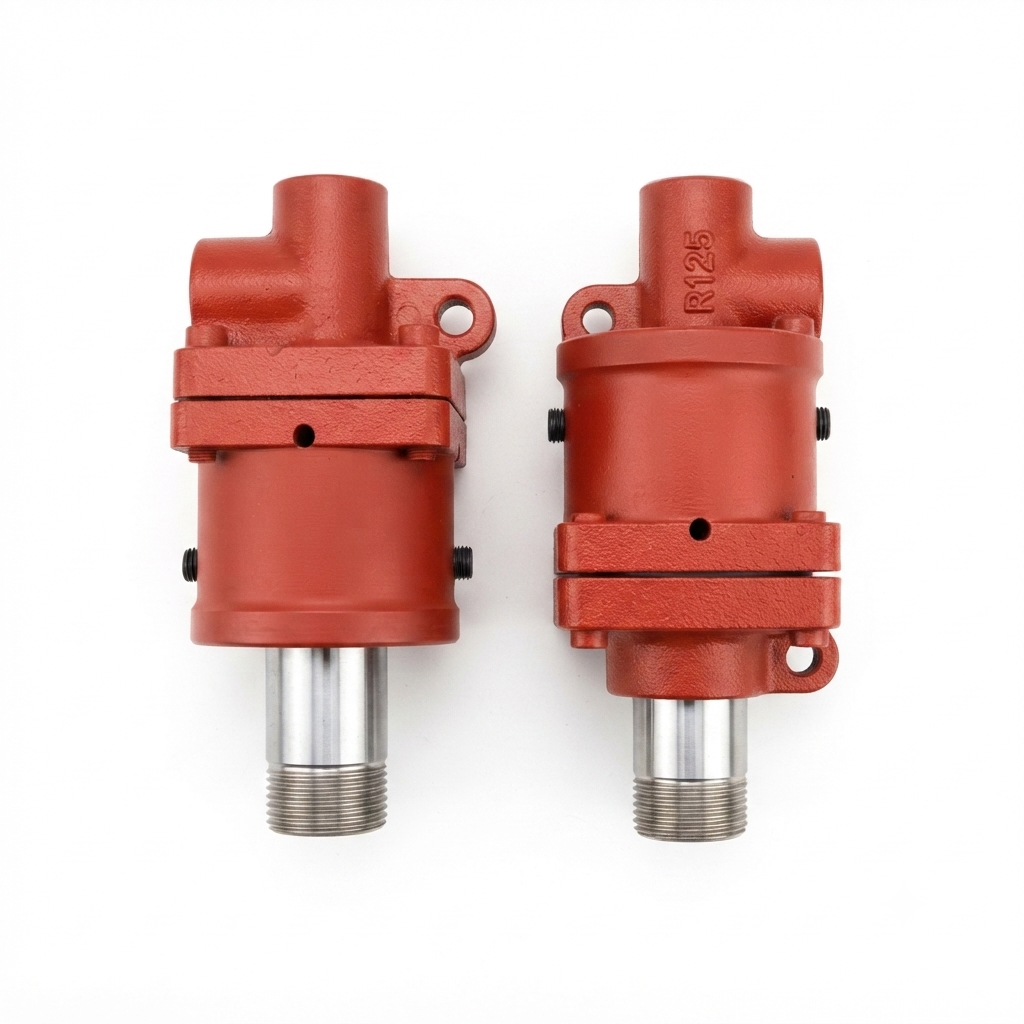
RTH Series — Rotary Union & Joint for Water/Coolant
Patented balanced-seal design for smooth media flow
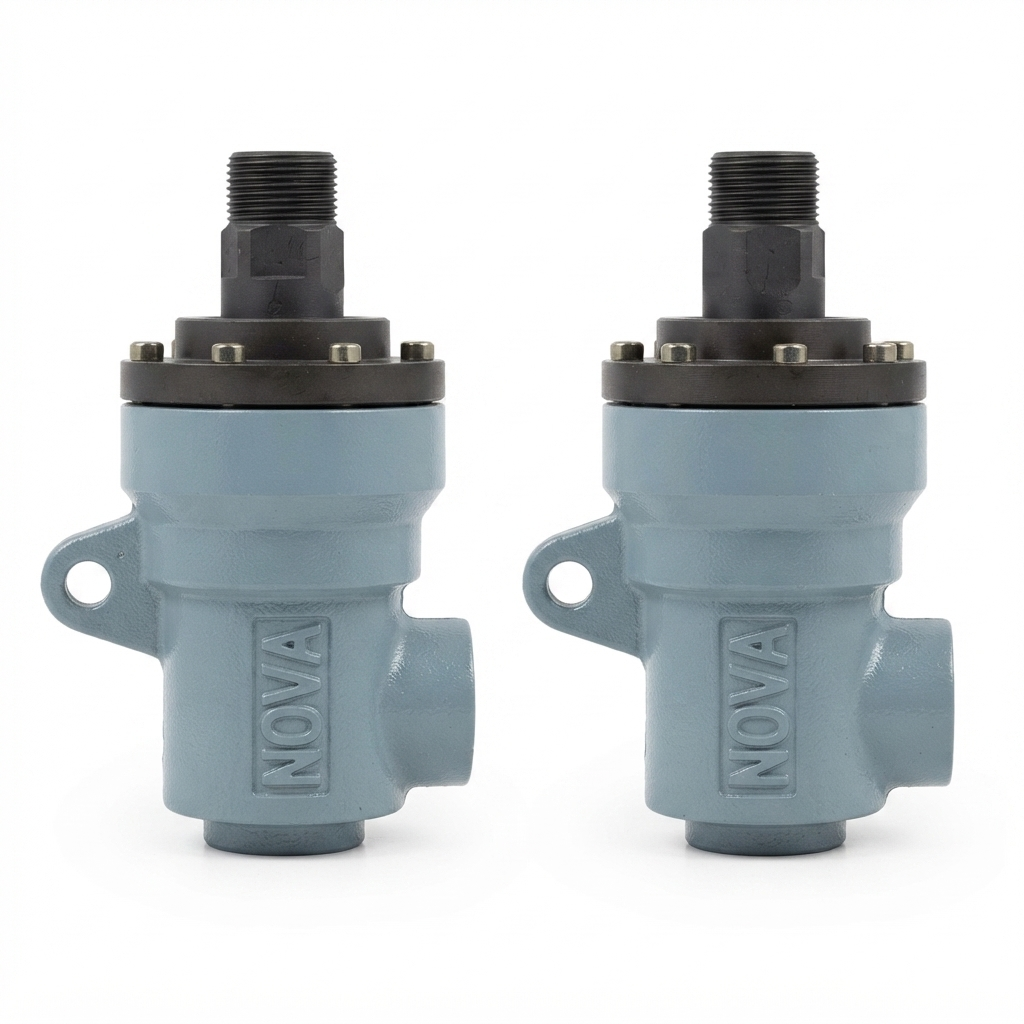
RTQ Series — Rotary Joint for Steam & Thermal Oil
Low-speed rotary joint for steam & thermal oil — dual-spherical graphite seal, 2.0 MPa / 350°C, 50–200 rpm. ISO 9001 quality, 60–80% below Western brands.
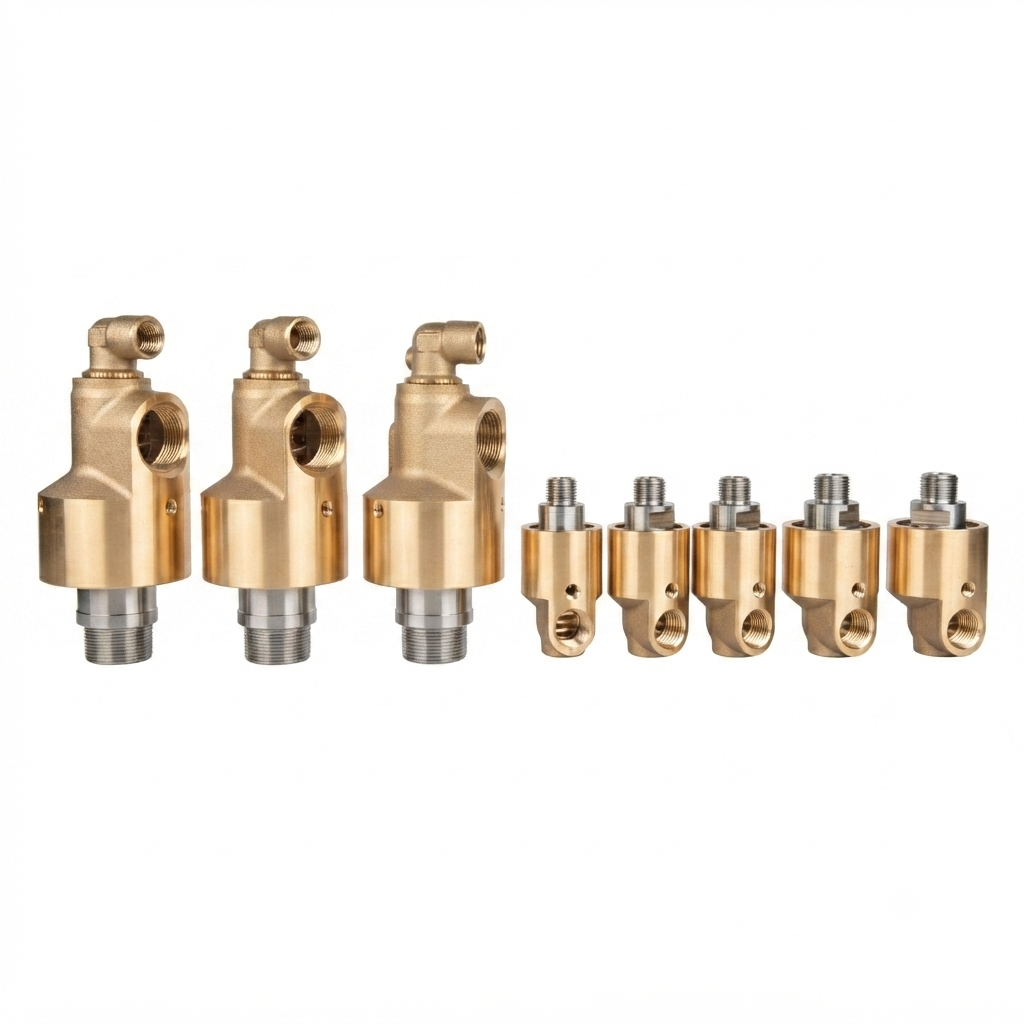
RT-DE Series — Rotary Union & Joint for Water/Coolant
Direct interchange with 55-57 series, forged brass housing
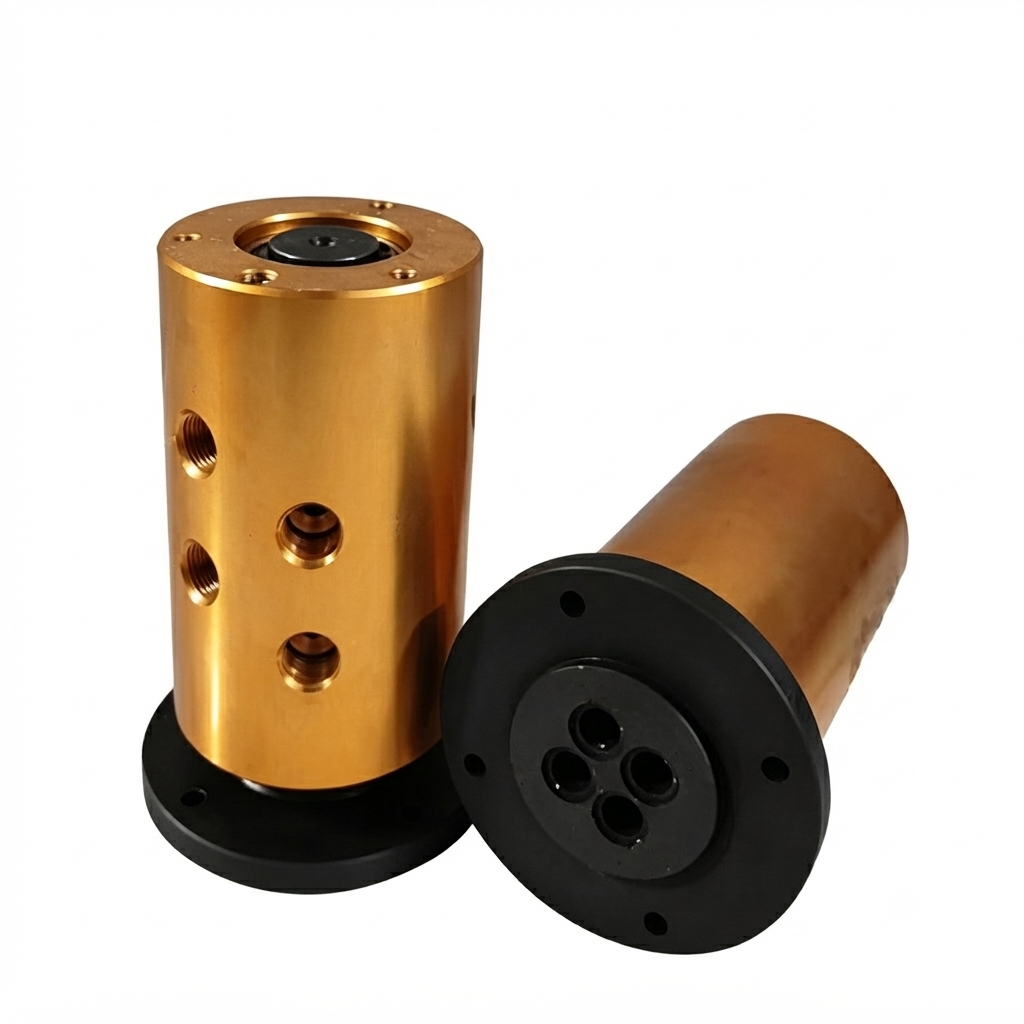
RT-GY Series — Hydraulic Rotary Union & Rotary Joint
Multi-passage hydraulic power transmission up to 100 MPa
Related Articles
How to Choose the Right Rotary Joint: A Complete Selection Guide
Choosing the wrong rotary joint leads to leaks, downtime, and costly replacements. This guide walks you through the 6 critical factors — media, pressure, temperature, speed, material, and connection — to match the perfect rotary union or coupling to your application.
8 min read Balanced Seal vs Unbalanced Seal: Which Rotary Joint Design Is Better?
Balanced and unbalanced seal designs fundamentally affect rotary joint performance, leakage rate, and service life. This engineering comparison explains how each design works, when to use which, and why Ruitus patented balanced seal technology delivers superior results.
7 min read Rotary Joint vs Rotary Union vs Rotary Coupling: What's the Difference?
Rotary joint, rotary union and rotary coupling are three names for the same device. This guide explains where each term is used, which names suppliers use, and what to specify when ordering — plus the one 'coupling' that is a completely different product.
6 min readSend Us Your Drawing or Duty Conditions
Tell us the medium, temperature, pressure, speed and connection size. Our engineers reply with a selection or a custom proposal — usually within one working day.