

Left-Hand vs. Right-Hand Threads in Rotary Joints: How to Pick the Correct Rotation
If you’ve ever had a rotary joint backed out of a journal while the machine was running, you already know how fast a simple thread choice can turn into a messy, expensive mess.
One of the most common questions our engineering team gets when maintenance managers or OEMs swap out rotary unions (especially when replacing Deublin, Maier, or Johnson components) is deceptively simple:
“Do I need a left-hand (LH) or right-hand (RH) thread, and how do I tell which one I’m holding?”
Getting this wrong usually ends one of two ways: either you can’t thread the joint onto the rotor at all during installation, or the machine’s rotation unscrews the joint under pressure during operation.
Here is a practical, no-nonsense guide to understanding thread handiness in rotary unions, how to identify what you have, and how to select the right one every time.
The Golden Rule: Self-Tightening Action
Why do rotary joints use two different thread directions in the first place? It all comes down to rotational physics.
When a machine shaft spins, it creates rotational friction against the stationary housing of the rotary union. If the thread direction matches the direction of rotation, that friction can gradually unscrew the joint from the shaft.
To prevent this, rotary joints rely on a simple rule: The thread must be selected so that shaft rotation naturally tends to tighten the connection.
Here is the quick rule of thumb for standard single-flow and dual-flow threaded joints:
- Clockwise shaft rotation (looking directly at the end of the rotating shaft) requires a Left-Hand (LH) thread.
- Counter-Clockwise shaft rotation (looking directly at the end of the rotating shaft) requires a Right-Hand (RH) thread.
Pro Tip: Think of it as opposing forces. If the roll turns clockwise, the joint needs to resist that motion by screwing in counter-clockwise (Left-Hand).
How to Determine Shaft Rotation (The Viewpoint Matters)
The most common mistake engineers make isn’t understanding the physics—it’s where they are standing when they check the rotation.
Always stand directly facing the exposed end of the rotating shaft or journal where the rotary joint will be installed:
[ Your Machine Roll / Drum ] ===> [ Exposed Shaft End ] <--- ( Stand Here & Look This Way )- Look straight down the centerline of the shaft.
- Watch which direction the shaft turns when the line runs:
- Moves like clock hands (top moves right)? That is Clockwise (CW) $\rightarrow$ Choose LH Thread.
- Moves opposite to clock hands (top moves left)? That is Counter-Clockwise (CCW) $\rightarrow$ Choose RH Thread.
Quick Visual Identification: LH vs. RH Threads
If you have an old rotary union on your workbench and need to verify its thread handiness before ordering a replacement, try these three quick checks:
1. The Slant Test
Hold the rotary joint vertically with the threaded rotor pointing up. Look closely at the thread crests:
- Right-Hand (RH): The threads slope upward to the right. When you turn it clockwise with your right hand, it advances away from you.
- Left-Hand (LH): The threads slope upward to the left. When you turn it counter-clockwise, it advances away from you.
2. Physical Groove Markings
Most industrial manufacturers (including Ruitus, Deublin, and BHS suppliers) engrave an identifying mark on LH threads to prevent workshop mix-ups:
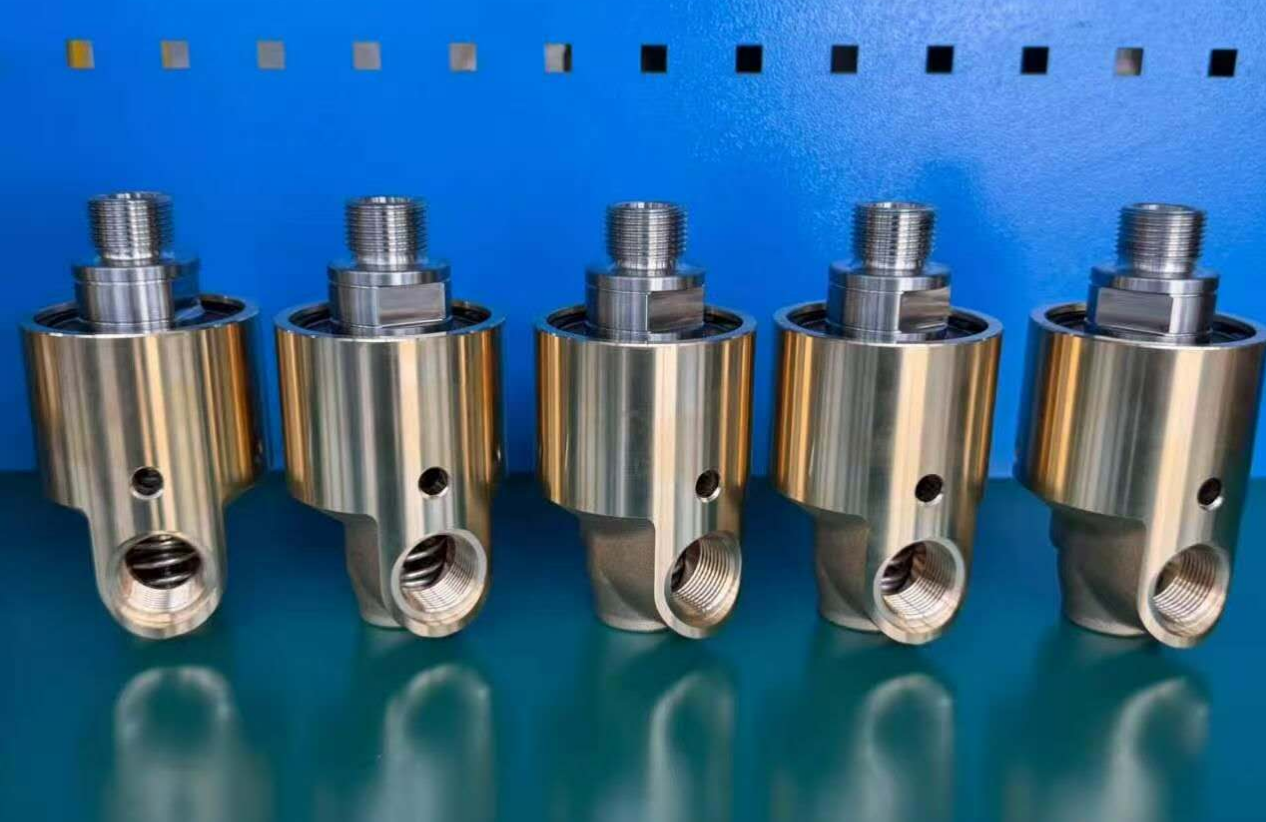
- LH Threads: Usually feature a small machined groove or notch cut across the hex flats or on the neck of the rotor thread.
- RH Threads: Have a smooth hex with no extra identification groove.
3. Check the Part Number Stamp
Rotary joint model codes almost always include thread handiness right near the size designation:
...-RHor...-R= Right Hand...-LHor...-L= Left Hand
Summary Checklist for Quick Ordering
| Shaft Rotation (Facing Shaft End) | Thread Direction Required | Visual Thread Slope | Standard Identification | | Clockwise (CW) | Left-Hand (LH) | Slants UP to the Left | Groove on Hex / Marked “LH” | | Counter-Clockwise (CCW) | Right-Hand (RH) | Slants UP to the Right | Standard Hex / Marked “RH” |
Still Not Sure?
If your equipment nameplate is worn off or you’re retrofitting an older corrugating roll, paper dryer, or printing cylinder, don’t guess.
Take a clear photo of the existing thread or shaft end nameplate and send it over to our technical team. We can cross-reference the dimensions, confirm thread pitch and direction within 24 hours, and ensure your replacement rotary joint drops right into place without machine downtime.
Related Articles
How to Find a Cost-Effective Alternative to Deublin Rotary Unions for Paper and Corrugated Box Machinery
Nov 2, 2026

What Is a Rotary Joint? Working Principle, Types & Selection
Oct 27, 2026
Can You Replace a BSP/G Thread Rotary Joint with a Deublin-Compatible NPT Thread Union Without Changing Machine Piping?
Oct 22, 2026
Send Us Your Drawing or Duty Conditions
Tell us the medium, temperature, pressure, speed and connection size. Our engineers reply with a selection or a custom proposal — usually within one working day.