

How to Find a Cost-Effective Alternative to Deublin Rotary Unions for Paper and Corrugated Box Machinery
If you run a corrugated box plant or a paper mill, you already know that rotary joints (rotary unions) are among the smallest components on your production line—yet a failure in one can bring an entire corrugator or drying section to a grinding halt.
For decades, Deublin has been the default gold standard for steam, thermal oil, and water applications in paper conversion. They make exceptional components. However, with escalating MRO (Maintenance, Repair, and Operations) costs, unpredictable extended lead times, and global supply chain shifts, reliance on a single brand often puts plant managers in a tough spot.
Finding a cost-effective alternative to Deublin rotary unions isn’t about buying cheap knockoffs that leak after three weeks. It is about understanding the mechanical engineering behind fluid transfer, matching the exact boundary conditions of your machinery, and partnering with an experienced OEM manufacturer.
Here is a practical, step-by-step technical guide on evaluating and sourcing high-performance Deublin alternatives specifically for corrugated box and paper machinery.
1. Understand the Unique Demands of Corrugated & Paper Machinery
Rotary joints in paper processing don’t operate in clean, laboratory environments. Before shopping for an alternative, map out the exact operating parameters of your equipment:
A. Corrugated Board Machines (Single Facers & Double Facers)
- Medium: High-pressure saturated steam (typically 1.0 to 1.6 MPa / 10–16 bar).
- Temperature: $160^\circ\text{C}$ to $210^\circ\text{C}$ ($320^\circ\text{F}$–$410^\circ\text{F}$).
- Speed: 150 to 350 m/min linear paper speed (translating to modest rotor RPM, usually under 500 RPM).
- Key Risk: Steam leakage ruins paper adhesion, causes edge de-bonding, and risks operator safety.
B. Paper Mill Drying Cylinders
- Medium: High-volume steam and condensate return (Duo-Flow / Dual-Pass setups).
- Key Risk: Thermal shock during startup and continuous thermal expansion of long dryer rolls.
[Fixed Syphon / Stationary Internal Tube]
                   │
  Steam In ──► ┌───┴────────────────────────┐ ──► Saturated Steam to Roll
               │   Rotary Union Assembly    │
  Condensate ◄─┼───┬────────────────────────┤ ◄── Siphon Pickup from Dryer
               └───┬────────────────────────┘
                   │
       [Balanced Mechanical Seal Ring]
2. Technical Checkpoints: Matching Specs Without Sacrificing Reliability
When replacing a Deublin 55 Series, 57 Series, or H/CK series steam joint, do not just match the outer dimensions. Audit these four internal engineering components:
① Seal Face Material Pairing (The Heart of the Union)
Deublin’s reputation relies heavily on seal face longevity. A reliable alternative manufacturer must offer identical or superior seal combinations:
- Silicon Carbide (SiC) vs. Silicon Carbide: Ideal for abrasive conditions or water lines where micro-particles are present.
- Antimony-Impregnated Carbon Graphite vs. Tungsten Carbide / SiC: The benchmark pairing for high-temperature steam and thermal oil. Antimony impregnation prevents blistering under severe thermal stress.
Rule of Thumb: Never accept standard resin-bonded carbon for steam applications exceeding $160^\circ\text{C}$. Always insist on antimony-impregnated graphite.
② Thread Specification & Taper Matching
A major headache in replacing European or American rotary joints in Asian-made machinery is thread mismatching:
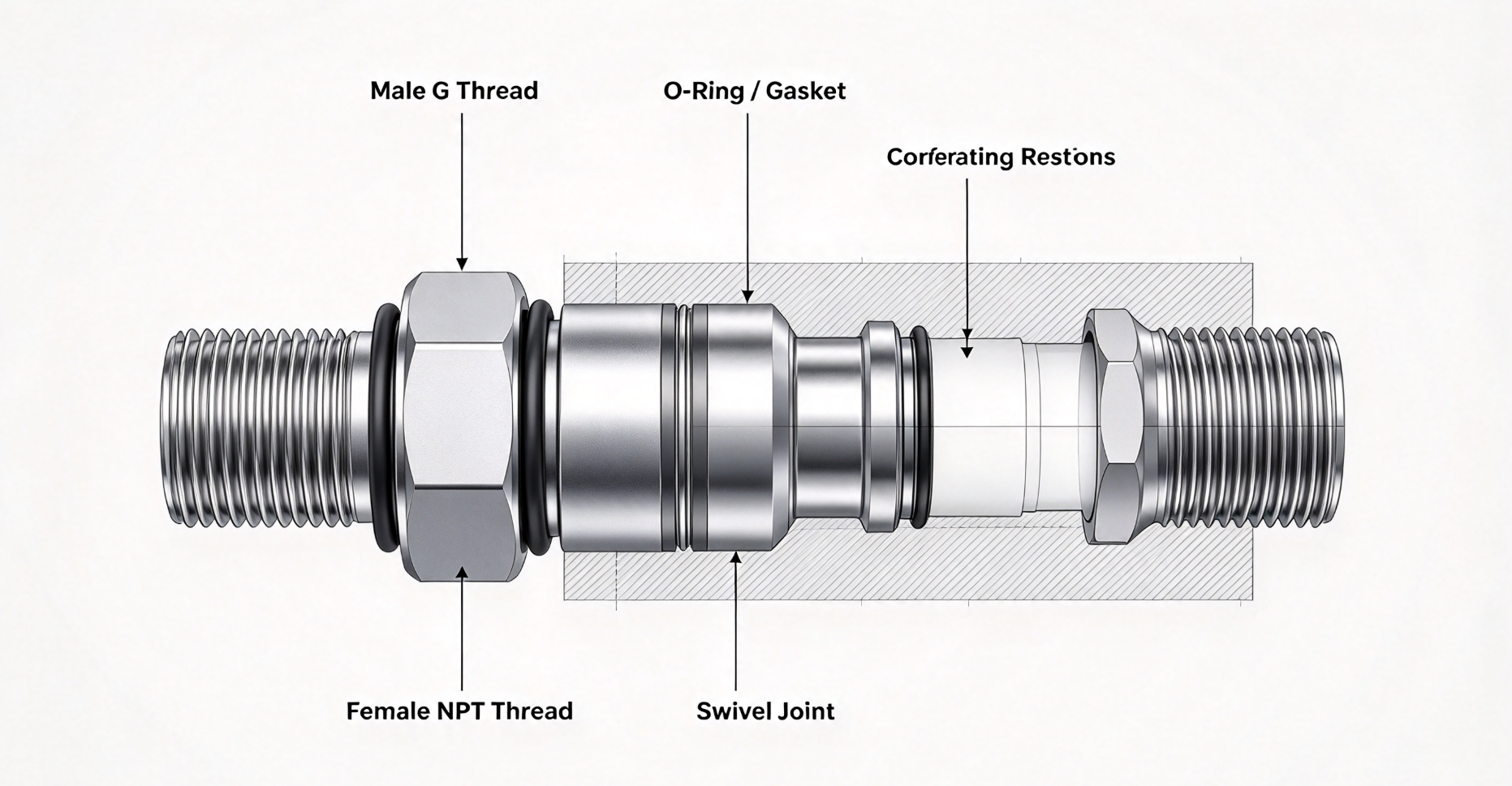
- NPT vs. BSP/G Threads: Ensure your supplier explicitly verifies thread profiles ($60^\circ$ taper NPT vs. $55^\circ$ parallel/taper BSP).
- Rotor Rotation Direction: Double-check Left-Hand (LH) vs. Right-Hand (RH) threads. Running a right-hand threaded rotor on a clockwise shaft will cause the joint to unthread itself during operation!
③ Compensation for Roll Expansion & Misalignment
Paper rolls expand linearly as they heat up. The alternative rotary union must feature:
- Dual-supported internal carbon bearings (or heavy-duty deep groove ball bearings with high-temperature grease nipples).
- Internal springs placed outside the fluid path to prevent debris clogging and spring fatigue.
3. How to Evaluate an OEM Manufacturer (Avoiding the “Cheap Copy” Trap)
The market is flooded with low-cost suppliers claiming to manufacture “1:1 Deublin equivalents.” To protect your equipment, vet potential suppliers with these three non-negotiable criteria:
┌─────────────────────────────────────────────────────────────────┐
│                    Supplier Evaluation Matrix                  │
├──────────────────────────┬──────────────────────────────────────┤
│ Metric                   │ Industrial Requirement               │
├──────────────────────────┼──────────────────────────────────────┤
│ Hydrostatic Testing      │ 100% factory pressure test before shipment│
│ Dimensional Verification │ GA (General Arrangement) drawing sign-off│
│ Raw Material Traceability│ Forged carbon steel/304 SS body certification│
│ Lead Time Guarantee      │ 7–10 days for standard modification  │
└──────────────────────────┴──────────────────────────────────────┘- Precision Machining Capability: Does the manufacturer utilize multi-axis CNC lathes and optical lapping machines for seal faces? Flatness on mechanical seals must be held within helium light bands (under 0.6 microns).
- Reverse Engineering Support: If you have an obsolete or modified Deublin model (e.g., FD 5100 or special flanged units), can the manufacturer work directly from physical samples or GA (General Arrangement) drawings?
- Transparent Warranty Terms: Look for manufacturers offering a clear 6-month to 12-month operational warranty coupled with clear guidelines on dry-running exclusions and proper flexible hose installation.
4. Cost Comparison: What Savings Should You Expect?
Sourcing directly from an established, specialized rotary joint manufacturer in an industrial hub (such as Xuzhou, China—backed by heavy machinery expertise) typically yields:
- 30% to 50% Direct Cost Reduction: Eliminating brand premiums and multi-tiered distributor markups.
- Reduced Downtime Risk: Standard models ship in 5 to 7 days, compared to 6–12 weeks of backorder wait times from traditional Western OEMs.
- Customization at Standard Prices: Modifying rotor lengths, adding grease nipples, or adapting flange connections can be done without astronomical NRE (Non-Recurring Engineering) fees.
5. Best Practices for Installation and Maintenance
Even the most expensive Deublin or Deublin-alternative union will fail prematurely if installed incorrectly. Ensure your maintenance crew follows these protocols:
- Never Use Rigid Pipe Connections: Always connect the rotary joint to supply piping using stainless steel flexible hoses. Rigid piping exerts massive radial loads on internal bearings, causing rapid seal destruction.
- Avoid Dry Running: Ensure media (steam, coolant, or oil) is present before spinning high-speed shafts.
- Flush the Piping: Before mounting a replacement joint onto an old corrugator roll, flush the condensate lines to clear iron rust, scale, and old tape residue.
Ready to Test a Drop-In Alternative on Your Line?
Switching supplier sources doesn’t have to be a leap of faith. Most reputable manufacturers encourage starting with a 1-to-2 unit trial run on non-critical roll positions (like pre-heaters or guide rolls) before converting an entire corrugator line.
Have a specific Deublin part number or a custom GA drawing you need cross-referenced?
Contact our engineering team today with your operating media, temperature, pressure, and thread specs. We will provide a 1:1 dimensionally compatible proposal within 24 hours.
Related Articles
What Is a Rotary Joint? Working Principle, Types & Selection
Oct 27, 2026
Can You Replace a BSP/G Thread Rotary Joint with a Deublin-Compatible NPT Thread Union Without Changing Machine Piping?
Oct 22, 2026
How to Find a Cost-Effective Alternative to Deublin Rotary Unions for Paper and Corrugated Box Machinery
Oct 22, 2026
Send Us Your Drawing or Duty Conditions
Tell us the medium, temperature, pressure, speed and connection size. Our engineers reply with a selection or a custom proposal — usually within one working day.