Sourcing Rotary Joints from China for Corrugators: 5 Critical Pitfalls to Avoid
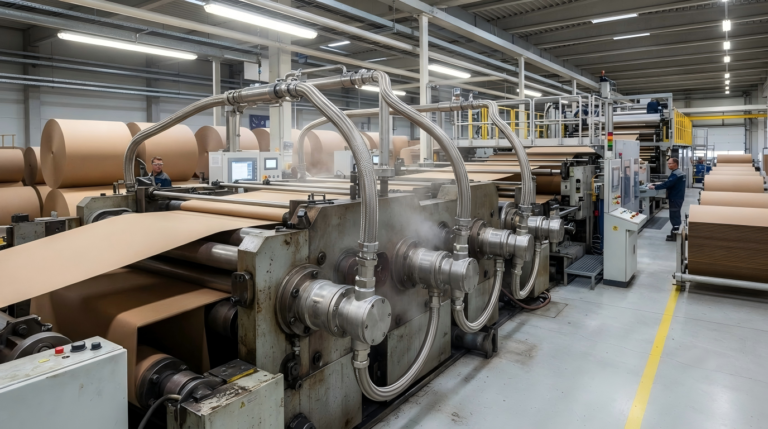
In the corrugated packaging and converting industry, your corrugator line runs at high speeds under intense heat and continuous pressure. When a rotary joint fails—whether due to sudden thermal oil leakage, internal scale-jammed springs, or high-temperature O-ring embrittlement—the cost is catastrophic: instant temperature drops, warped cardboard, massive material scrap, and protracted downtime.
When plant managers and procurement teams look to China to source cost-effective replacement rotary joints or OEM alternatives, they often face a sea of suppliers. How do you find a reliable manufacturing partner instead of falling into low-quality traps?
Here are the 5 critical factors you must consider when sourcing rotary joints from China:
1. Material Integrity Under Extreme Temperatures ($350^{\circ}C+$)
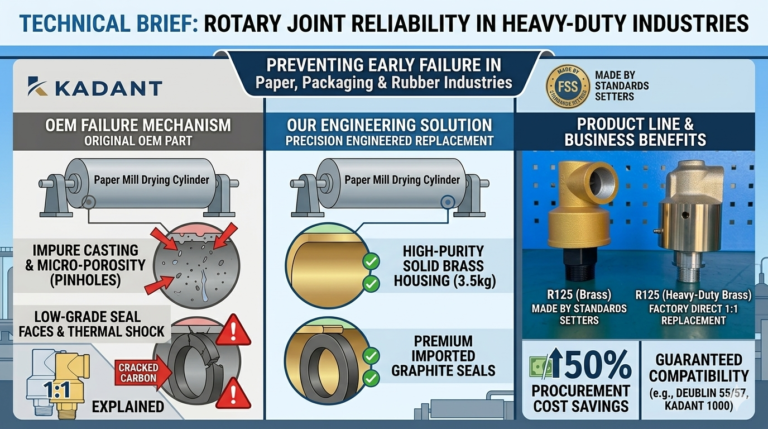
Many low-tier suppliers use standard rubber O-rings that quickly turn brittle and crack when exposed to continuous high temperatures (above $120^{\circ}C$), leading to sudden steam or thermal oil sprays.
-
What to look for: Ensure the manufacturer uses imported high-temperature graphite seals and advanced elastomer upgrades (like FFKM for extreme conditions) designed specifically for thermal oil and high-pressure steam up to $350^{\circ}C$.
2. Anti-Scale and Anti-Flooding Design
In water-cooled or steam-heated rollers, mineral scale easily builds up inside standard internal springs, causing them to jam and trigger sudden water floods into your packaging area upon restart.
-
What to look for: Ask your Chinese supplier if they utilize patented external multi-spring designs (such as RTH series mechanics) which keep flow channels unobstructed and prevent scale-induced failures.
3. True Manufacturing Capability vs. Pure Trading
The Chinese market is flooded with trading companies that resell items with little engineering control. A rotary joint is a precision component requiring strict machining tolerances.
-
What to look for: Partner with integrated manufacturers who have in-house CNC machining centers, precision grinders, and dedicated testing equipment certified under ISO 9001. Direct factory auditing (via video call or on-site) ensures consistent quality.
4. Customization and Engineering Support
Every corrugator machine model (whether BHS, Fosber, or Mitsubishi) has unique mounting dimensions, port sizes, and fluid requirements. Off-the-shelf catalog items may not always fit your exact setup.
-
What to look for: Choose a supplier with strong R&D and engineering capabilities who can offer custom passage numbers, specific flange connections, and tailored pressure ratings rather than just selling standard boxes.
5. Cost-Effectiveness vs. Cheap Junk
The goal of importing from China is lowering your Total Cost of Ownership (TCO) without sacrificing performance. Buying the cheapest joint on the market will only result in a 3-month lifespan, costing you thousands in unplanned downtime.
-
What to look for: Look for a reliable “import alternative” brand (such as Ruitus RT-DE or RTQ series) that bridges top-tier performance with factory-direct pricing, extending service life from a few months to well over a year.
Bottom Line:
Sourcing rotary joints from China can dramatically cut your maintenance budget—if you partner with the right manufacturer.
Are you currently facing high failure rates or seeking a reliable, high-durability replacement for your corrugator lines?
💬 Let’s connect! Drop a comment below, or visit www.ruitus.com to discuss your specific technical parameters (Media, Pressure, Temperature, Speed) with our engineering team.
#RotaryJoint #CorrugatedPackaging #PaperMill #IndustrialMaintenance #SupplyChain #MadeInChina #Ruitus